
Taming The Monster
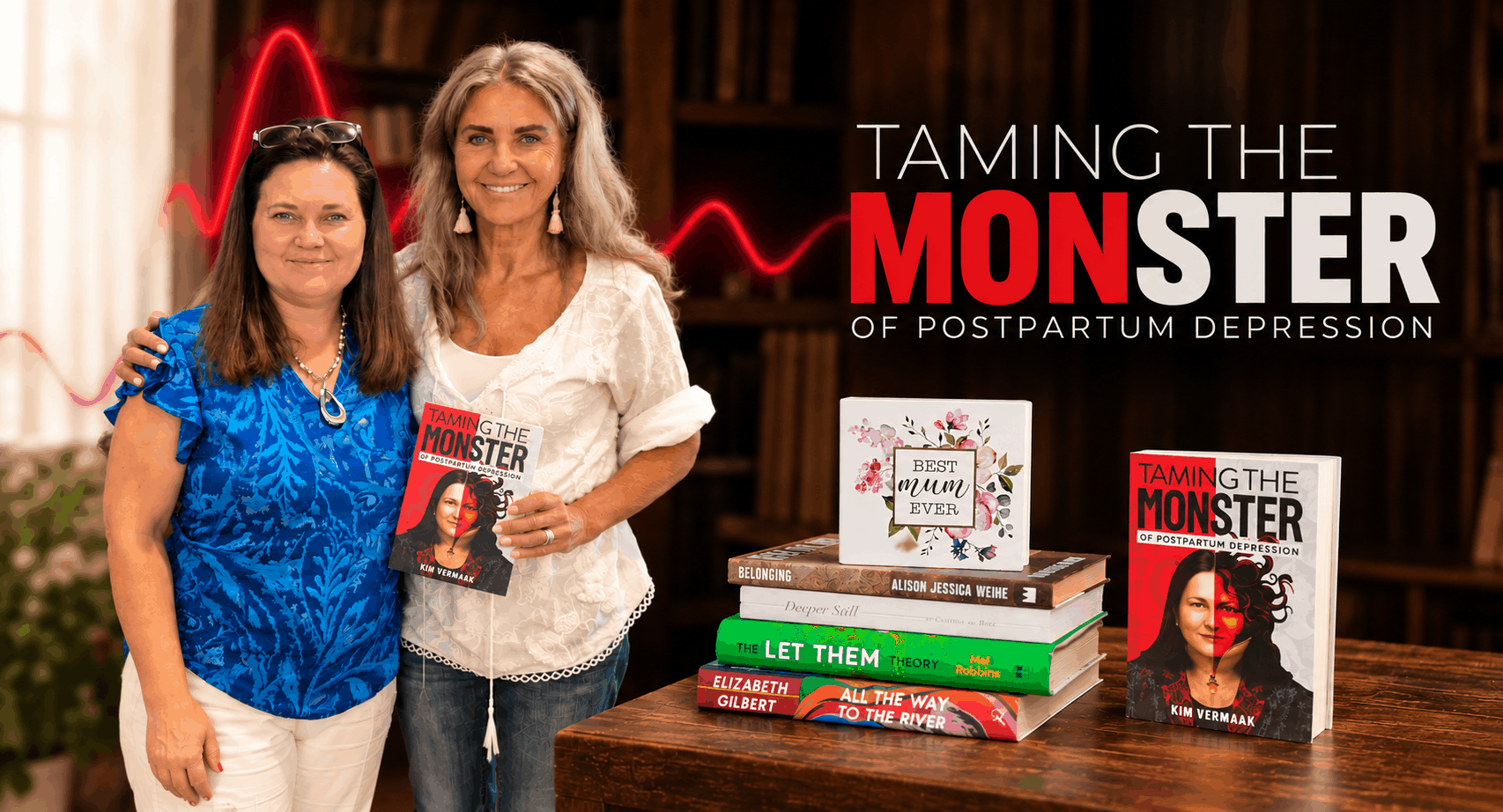
Author Kim Vermaak and Alison Weihe share a warm moment together with Kim’s book, Taming the Monster of Postpartum Depression.
It was a cold, rainy weekend. The soft fingers of rain drummed on the roof as I cocooned myself into reading Kim's remarkable book. I sensed it was going to be profoundly moving, but I did not realize that her courage would evoke my courage to tell my raw truth.
The timing of the release of Kim Vermaak's remarkable book, "Taming the Monster of Postpartum Depression", could not have been more poignantly surreal, nor more agonizingly relevant.
The complex, layered world of postpartum depression is globally on trial.
The devastating ache of every day in the Lindsay Clancy trial has come to haunt us all. When a journalist covering the trial said, "I believe Lindsay did not get enough help from the system", three of her own sons vehemently disagreed with her. For them, it was a simple narrative. She had killed her children and must face the consequence of her devastating actions. Others clamoured that she had been given more help than most women in society battling postpartum depression.
Everywhere, an opinion sat on the great divide of judgment and of definitive positioning. But the hung jury revealed the agonizing complexity. Beneath this moment and a story that had gripped the psyche of the nation was the voice of motherhood and postpartum depression beyond a single narrative.
This complexity lies at the heart of paradoxical thinking. Where, despite a polarised world, things are not “either or", but "and". Layered and complex. Wrapped in culturescapes and shifting expectations. Wrapped in complex family dynamics and patterns and a shifting heaving sea of shame.
That is what Kim's remarkable book attempts to delve into. The complexity, the shame, and the anguish beyond a single narrative. With the advent of social media and the rise of our collective intelligence through AI, we have all somehow become spectators in the shadow of shame, in the spectacles of other stories.
We often sit in silent surrender at how this could have happened. This moment in the history of our humanity unlocks a searching to see beneath the shame, a searching to find greater answers for the anguish so often hidden from society.
That is what Kim's brave work of legacy has unlocked for me.
Kim revisits with painful and brutal honesty how she had to navigate a journey with her own inner monster. A young single mother. An adopted child who decided to break the pattern of abandonment.
But it was not an easy journey. It was harrowing. The anguish of trying to fend for her baby and still keep afloat. Constant cycles of sleep deprivation and absolute terror made her become someone she couldn't recognise.
Until she stared the monster in the face and finally sought help.
Help that slowly, slowly started to piece her life together again. One small act of sanity after another.
What Kim's extensive research and delving into others' stories reveals is the crushing loneliness of isolation.
She stood at her church with her baby in her arms, smiling politely and answering, "I'm fine", when every part of her soul was screaming. Screaming to be seen. Screaming to be heard. And screaming to be felt.
As Kim so beautifully writes:
"We have created a society that applauds mothers who push through and labels the ones who fall apart. But pushing through should not come at the cost of our emotional safety or our souls. This book is an invitation to stop running, stop masking, and to sit with the discomfort of what it means to parent while healing.”
“It is an invitation for those of us who inherited broken legacies and courageously built them, rebuilt them. It is for the women and men who are still listening to the parts of themselves they were told to silence.”
“Healing is not about silencing your symptoms. It's about being heard. It's about recognising that the monster isn't always the villain. Sometimes it's the only part of you brave enough to say something is wrong.”
“When you stop long enough to listen to that voice, and when the people around you stop long enough to really see you, that is when the taming begins. That is when healing finally finds a place to sow its seeds in your heart.”
“What I did not yet understand at the time was that the coping mechanisms our families handed down, the silence, the self-sufficiency and pretending to be fine, had never worked. Not for my parents and certainly not for me.”
“I was not protecting myself or my baby. I was just feeding the monster. Research backs up the idea that healing happens in community. When we isolate ourselves, which is the very first thing depression tells us to do, our monster speaks even louder. But when we bring our pain into the light, and someone across the circle nods and says, 'Me too', the monster shrinks back.”
“Support groups connect us in a human way. They remind us we are not alone, that our experiences matter, and that healing, though not always easy, is entirely possible. And sometimes that healing really begins in a room full of strangers sitting on the floor and passing around muffins.
It begins when someone looks you in the eye and says, 'I understand'.
In that moment, the monster loses its power, and you find yours. "
Extracts from Taming the Monster of Postpartum Depression.
My own journey into motherhood was not an easy rite of passage.
I was wracked with "not good enoughness". Filled with shame of past experiences that had shaped my life. Experiences that my now new family knew nothing about. I had kept my past hidden.
I had so badly wanted to be a mother. I had so badly wanted to feel a sense of belonging. So, when I met my husband in my mid-thirties, he came into my life as a sea of calmness. A man who would help me navigate the stormy passages where old demons reared their head and the spectres of shame came back to haunt me.
I had been a political activist for almost 20 years when I met him. I had almost no experience of looking after other children. I had briefly looked after my friend's baby in England, for two brief hours while she went to the pub. All I could remember was constantly checking that he was still breathing, lying there in his cot.
The thought of motherhood was exhilarating because it was what I had always dreamed of, having a family. But at the same time it was terrifying because I had no road map. And what I battled the most was a sense of isolation.
At the hospital, I tried to make friends with some other lovely women in my ward, but they all had their own circle of friends.
And whilst my husband's German family was incredibly supportive. I smiled and laughed and hosted parties, but inside my internal dialogue of shame was crushing.
When I went to a Moms and Tots group in Linden, where we were living, I battled to relate to the other moms.
I was much older. In the early years of parenting, I was the major breadwinner, trying to do extra freelance work while still building up a fledgling company with my husband.
The exhaustion took its toll, and working sometimes till midnight doing admin to keep this little company afloat would often make me feel frayed and overwhelmed. Brittle and exhausted.
And so, I defaulted into the terrifying pattern I had grown up with. My father had been severely bipolar, and whilst he never physically harmed us, his devastating highs and lows, his crushing rages, and his threats of suicide made me grow up treading on eggshells, never knowing when the next terrifying episode would erupt in the squeal of tyres roaring off into the night.
As a new young mother, I felt overwhelmed at times. There were times when slammed doors mirrored the devastating drama I was recreating in my own home. I thought it was learnt behaviour, reflecting back on it later in life. Another time I threw a coffee cup against the wall and its cruel mark left a scar on the wall.
But the scars went deeper than the paint. They robbed my joy. They robbed me of presence. Of savouring each precious moment with my children.
Now, as I dig deeper in brutal honesty about my life, I see that it came from an overwhelming sense of "not-good-enoughness", a sense of shame that had suffused my life.
There were times when my husband became both mother and father, tenderly brushing my daughter's hair when my impatience drowned her sensitivity. I was not a kind "Kumbaya" kind of mother. I was practical. Juggling so many balls in the air in relentless survival, building up this little company. Against all odds. My children were always well-dressed and cared for on the outside.
But my not-good-enoughness kept me locked in terror, kept me always wondering, "what will people think"? The voices of shame were never far from my apparent coping on the surface.
Decades later, I have watched my two beautiful children emerge into such kind, gentle, ethical and wise humans, both here to make a difference in the world in their own unique way.
I am learning to tame my own monster, my own monster of "not-good-enoughness", a not-good-enoughness that plagued my entire life, the monster of shame.
Shame is the lowest frequency of all the emotions we feel. It is the deepest, the darkest and the most debilitating.
It is only when I finally had the courage to tell my own story around my journey of shame that I finally was set free. From my brokenness, defining lessons gently reshaped my sense of self and allowed me to become a different person and claim a new identity.
Today, my most treasured possessions are not things, but the memories I hold in my heart.
There is a plaque that I have in the bookshelf in my lounge, tightly perched above some meaningful books. It's a plaque my daughter gave me on her wedding day in Australia. It says, "World's Greatest Mum".
I cried when she gave it to me.
It felt surreal.
You see, growing up, I had felt like such a worthless mum, so full of anguish and so little presence. I loved taking my children for outings. I loved doing things with them.
But I never seldom laughed with them, the way I do now, free from the anguish of the past. The hidden shame of my past then blotted out the joy of my presence.
That's what shame does.
It fills the room of your soul with darkness, and you battle to see even a glimmer of light.
Shame suffocates your soul, and it buries your sight.
It buries your insight.
It prevents you from seeing. It blinds you in your darkness.
And that is where fear breeds.
The isolation of depression deepens in the darkness of our solitude.
That is what Kim's heartrending book reveals: that healing comes in community.
It comes in breaking the silence.
It comes in being seen, being heard, and being felt.
Now my greatest joy is becoming a grandmother to the most beautiful little boy, Theodore, an angel of healing. My daughter is the most remarkable mother, utterly present, so calm, so measured, so wise. She has broken the cycle, just as Kim did. She has broken the cycle by becoming a mother with peace in her soul and a heart to help others.
And I have broken the cycle by becoming a mother to many, not just my biological children. I have broken the cycle by becoming a mothering mentor.
In a life I never anticipated, through my speaking and writing journey, I have met many remarkable young women.
Young women who told me that my message made them feel less alone.
My courage to tell my story, written over four long years, broke the silence of the shame, and Kim helped me walk that road.
Kim helped me become whole. She made me feel less alone.
A few years ago, when I appeared on Soweto TV, I was coined "Mama Gold".
Mama Gold is my healing.
Mama Gold is my second chance.
Mama Gold is the story of a woman who finally found healing when others adopted her to become their mother as well.
That is when she truly felt like a kind, calm mother at last, a grandmother of peace.
That is how my monster of not-good-enough-ness, the monster of shame, was finally tamed.

